
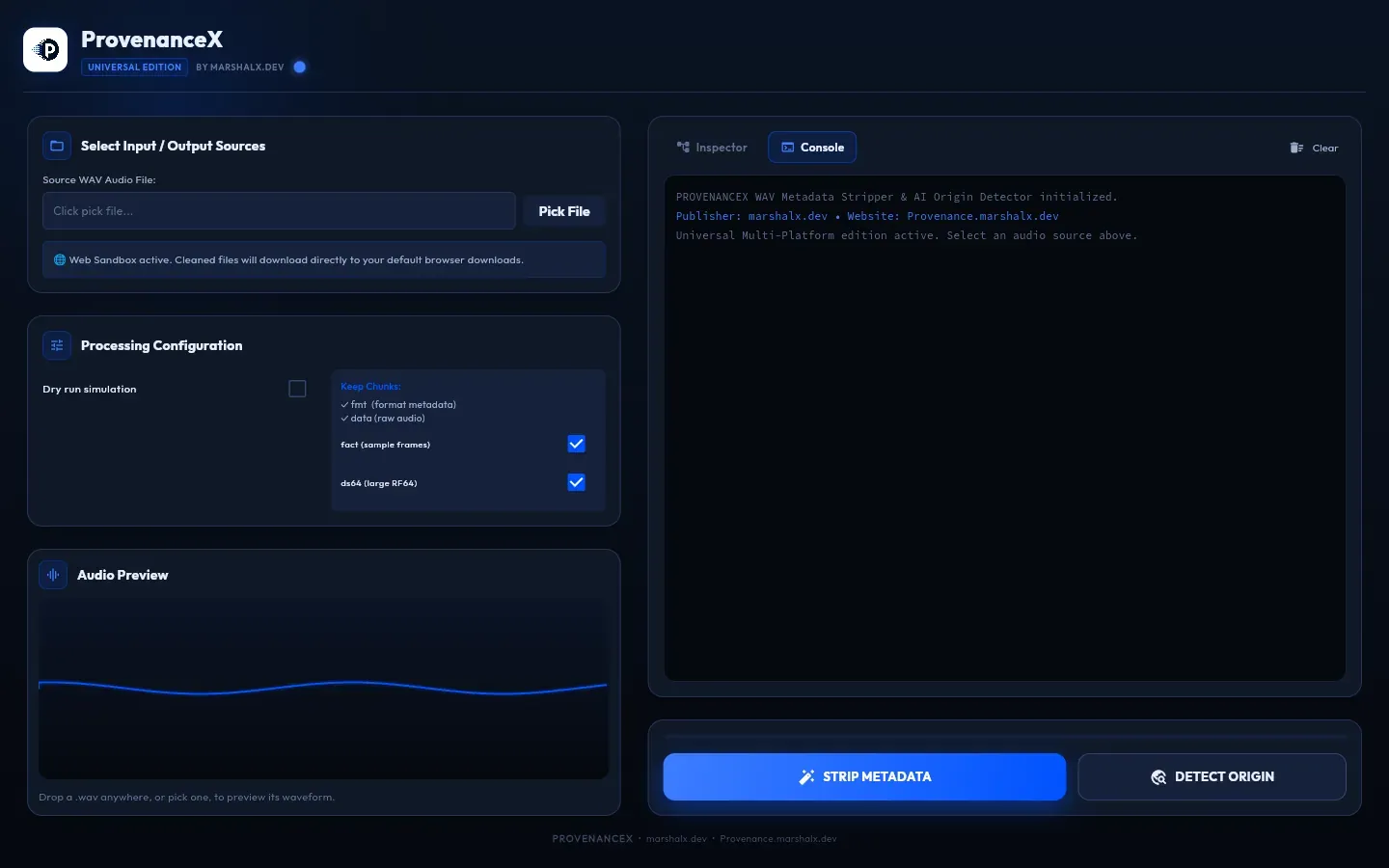
A WAV file is a row of labelled blocks, called chunks. Two of them are the sound itself: fmt says how the audio is stored (its sample rate, bit depth and channels), and data holds the samples. Everything else is optional, and that is where a file carries its story: LIST/INFO tags with a title, an artist or the software that made it, bext from broadcast tools, iXML from field recorders, ID3 tags, and more and more often a C2PA manifest, a signed record of how the file was made.
ProvenanceX, which I built this week, opens those chunks and shows you every one of them, with its size.
Looking for AI
To judge whether a file was generated, ProvenanceX weighs three kinds of evidence:
- A C2PA content credential, which tools that sign what they make leave in the file.
- Generator fingerprints that particular services leave in metadata. It knows those of Suno, Udio, OpenAI and ElevenLabs.
- The sound itself: heuristics over the waveform’s spectrum.
It returns a probability and lists every signal it found, rather than a bare yes or no, so you can see why it decided what it did.
The first two are clear when they are present, but they live in metadata, and metadata can be removed: a file with neither is not proven to be made by a person. The third looks at the audio, so it still has something to say about a file whose tags are gone, but a heuristic is a hint, not proof.
Removing metadata
The other half of ProvenanceX strips the chunks you do not want, such as tags naming the software, the machine or the person that made a file. It keeps fmt and data (and fact and ds64 where a file needs them), so the result plays exactly as before: the samples are not touched.
Large files, nothing uploaded
Files stream through in 64 KB blocks, so memory use stays flat whether a recording runs three minutes or three hours. And all of it happens inside your browser. The file is never uploaded, which matters for audio you have not released yet.
ProvenanceX is free at provenancex.marshalx.dev.